It's undeniable that reality television has become a significant part of all of our lives. We all fall into two categories with reality TV: the people who perpetuate the craze by watching and discussing shows like Jersey Shore, the Bachelorette, and any of the Real Housewives franchises at length, and the people who deal with all of the conversation, but are confused by the general public's fascination with all of it. I fall into the latter category. Unfortunately, as other people who fall into this second apathetic category can attest, we can't completely avoid learning about these shows, they're such a huge part of pop culture that we're expected to at least be familiar with the characters and general story lines, the same way people are expected to be aware of the Harry Potter or Twilight franchises, whether we've read the books or not.
 |
| Oh Ashley, you can do so much better than Bentley. |
These characters, who are especially unique because they have no discernible talent or characteristic other than the willingness to allow their lives to be filmed, pop up everywhere in our lives. Sometimes you might hear Stacey King or the Funkenstein make a reference to Scottie Pippen's wife's participation in the Real Housewives of Miami. Or maybe you're watching a roast of Donald Trump on Comedy Central and you have to endure one of the worst "comedic" flops of all time when, for some inexplicable reason, Jersey Shore's "the Situation" is asked to speak:
http://www.youtube.com/watch?v=LEx3mYck-2c (Ice T's reaction around the 3:20 mark is priceless). Reality television has become such a integral part of our lives, we've spawned movies like EDtv and the Truman Show which are entirely about characters who's lives are documented in the form of a reality show. As I was "watching" the most recent episode of the Bachelorette with my girlfriend (by "watching" I mean checking baseball box scores on my computer and then glancing at the show when someone starts yelling, cursing, or hooking up), I started thinking about our society, and the type of people that really enjoy these shows, and why.
Of course, the process of analyzing the types of people who like or dislike reality shows went down a road of generalizing and over-simplification, but I still came to some reasonable conclusions that are backed up by the people I know and the experiences I've had. It's a small sample size, I know, but think of it more as my own case study.
Here it goes: I think it's fair to say that the majority of reality shows are geared towards women. This is obvious with the Real Housewives franchise, but I think it's safe to say that most of the dating/relationship reality shows fit this category too; generally speaking, women are more fascinated with romance, and the fact that it's real (or as real or unscripted/edited as anyone can believe reality shows to be) makes it infinitely more interesting than a romantic comedy with a predictable ending. This idea is manifested in shows like The Bachelor/Bachelorette, Blind Date, Cheaters, The Fifth Wheel, and Elimidate (side note: I am an exception to my own generalization, Elimadate was a fantastically trashy show, I absolutely loved it). Sure there are many other reality shows that generally appeal to men and women, like Survivor, or Jersey Shore, and while I haven't done the demographic research or taken any polls, I feel confident that, generally speaking, women are consuming more reality television than men, mostly due to the subject content of the reality shows.
Where the enjoyment comes from with these shows is pretty clear; there's a cast of characters that viewers can identify with, and the more viewers watch them, the more they get used to their characteristics and idiosyncrasies. Viewers can see a little of themselves in certain characters, and a little of their friends or foes through the actions of other, less desirable characters. Viewers root for the characters they like and identify with, and the entertainment value comes from how they interact with the other characters, especially the ones they don't like. Even though viewers of reality shows aren't naive and would never feel like their actions or thoughts truly affect anything happening in the show, the fact that they identify with certain characters allows viewers to really feel like they are a part of the show. Since these programs are (allegedly) unscripted, it creates a different type of tension for the viewer and makes them feel like a part of what's happening, as they can see how the characters that they're familiar with adapt to certain scenarios, and compare that to how they might have reacted.
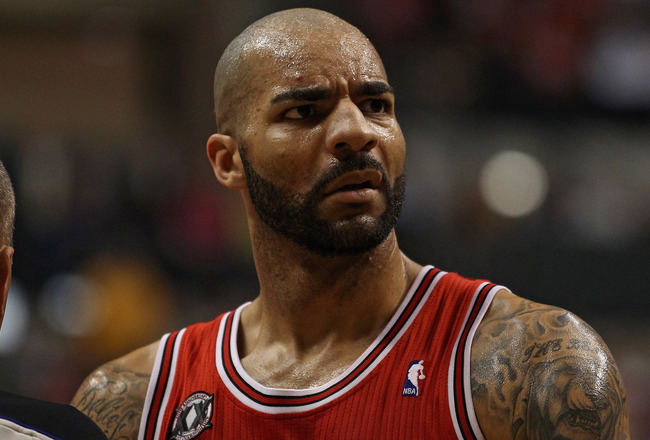 |
| I'm confused too Carlos. Where's the 20-10s you put up in Utah? |
Male sports fans enjoy this kind of entertainment every day; this void in their life is already filled. Read the previous paragraph and replace the word viewer with fan, the word character with player, and the word program or show with game. The enjoyment derived is exactly the same, only the medium is a ballgame instead of a reality TV episode. I watched all 98 Bulls games this year (mostly on DVR, with a lot of fast-forwarding to the 4th quarter), but as the season progressed, it was essentially a reality show for me and the way the players (characters) of the league developed was completely enthralling. The maturation process of league MVP Derrick Rose was incredibly satisfying, as he did it with a combination of humility, while stepping up in the most important moments and oftentimes willing his team to victory during the regular season. Luol Deng stepped up in a big way and played up to his contract value for the first time this year with his newly developed 3pt shot and his suffocating defense, and I could always look forward to some energy plays and craziness from Joakim Noah. The bench mob was always fascinating as they brought an exuberance that you don't see from most benches in the NBA, and the starters fed off of their intensity. I rooted for Boozer to perform the way he did in Utah all year, and whether he was injured or just getting older, his issues throughout the season provided an intriguing (and frustrating) subplot to the season. All of this is without even mentioning the clear cut villains the Bulls were competing against in the Eastern Conference: the mighty Celtics who ousted the Bulls in the greatest first round series in the history of the sport 2 years ago, and obviously the Big 3 in Miami; after both LeBron and Wade turned a cold shoulder to the Bulls in the offseason in order to join forces and try to start a dynasty in South Beach.
The point is, when a fan follows a team, he/she gets familiar with the players, and what happens with that team becomes a part of their life. My girlfriend sets the DVR to record the Bachelorette episodes, and will carve out time every week to sit down and enjoy them, because she looks forward to seeing what Ashley is gonna do next. Will she finally come to her senses and throw Bentley out on his ass? Who knows? But in the exact same way, when the NBA lockout ends and the next Bulls season starts, I'll be sure to set the DVR and sit back, relax, and strap it down while enjoying the sounds of Stacey King and Neil Funkenstein narrating DRose and the Bulls' next chapter. Can Rose win back to back MVPs? Will Chicago be able to find a ball-handling 2 guard who can help them get past Miami? Do the Bulls have a shot to win their first title since Michael Jeffrey Jordan graced the starting lineup? Who knows? All I know is that I can't wait for next season.

Nicely done, Scott!
ReplyDeleteJF Bradfield
Sr. Writer/Editor
Ellenbecker Communications