Saturday, December 24, 2011

Why Rip Hamilton Gets Me Excited for the 2011-12 Bulls

The Bulls better let Rip wear his headband. I'm serious.
After the Chicago Bulls' devastating 4-1 Eastern Conference loss to the Miami Heat last year, every Bulls fan has spent the offseason wondering what the Bulls needed to do to get past Miami in 2012. The obvious need for upgrade was at the SG position, and while there were several solid FA possibilities, almost all of them came with a disclaimer. Tracy McGrady and Vince Carter are too old and need the ball to be effective, Jason Richardson was too expensive, Aaron Afflalo was a restricted FA, and with most of Denver's backcourt in China (Wilson Chandler and JR Smith), they were certain to match any offer sheet. The more expensive players like Afflalo would have required some kind of trade anyways if the Bulls were to stay under the salary cap, and the thought of the Bulls thinning out their frontcourt depth by trading away someone like Asik or Gibson seems like it creates more problems than the improvement at SG solves.

When Detroit amnestied Rip Hamilton though, he became an inexpensive option that didn't require the Bulls to trade anyone. Sure, there are reasons Rip comes at a discount: at 33, he's on the wrong side of his peak years, and due to his age he doesn't have the same explosiveness and athleticism he had in his championship season with the Pistons in 2004. As Rip's quickness has waned, so has his shooting accuracy in recent years. But Bulls fans who point at these truths as the primary reason the Bulls can't catch up to the Miami Heat this year are using flawed logic; Hamilton's impact at the SG position shouldn't be graded against the stud shooting guards in the NBA, but rather against the Bulls' SG situation last year. No disrespect to Keith Bogans, who is a solid veteran defender, but the way Hamilton compliments the rest of the Bulls starting 5 really opens up a lot of possibilities on both ends of the floor for the Bulls. Here's how I see Rip impacting the Bulls:

1) Rip's presence will allow the Bulls to be one of the best fast-break teams in the league. Chicago's best offense has been their solid defense under Thibodeau; they force turnovers, then get easy buckets in transition. They were great at this last year, but Rip can take this to another level. Bogans isn't nearly as quick or as conditioned as Rip, and he's not nearly as good of a finisher in the open floor as Hamilton is. This is not a knock on Bogans, this just happens to be one of Hamilton's strengths. Now Derrick has someone who can almost keep up with him on the break. Don't forget the Bulls can also run with Deng, someone who can finish at the rim or spot up at the 3 point line in transition, and Noah, who is without a doubt the best center in the NBA on the fast break. The LA Clippers might be Lob City, but if everything breaks right (pun intended), the Bulls could become Layup City.

"A competent coach? This is weird..."
2) More assists, less offensive burden for Derrick Rose. It was annoying to hear over and over again last year, but the Bulls truly were playing 4 on 5 when they were on offense. Bogans stood at the 3 point line, and didn't move without the ball at all, and teams didn't bother to even guard him since they'd certainly rather have him jack an open 3 then let Rose, Deng, or Boozer beat them. Now, Derrick will have another reliable option to kick the ball to when defenses inevitably collapse on him. Bulls fans should try to remember that Rip is a scorer. He's averaged over 17 PPG in his career, and he's consistently put up double digits per game since 2000, despite the fact that the last couple of years he's been a focal point for opposing defenses while playing for a coach that he hated on a terrible team that was awful at moving the ball effectively (this happens when you sign Ben Gordon and Charlie Villanueva for way too much money). Now Rip is going to be the 4th offensive option for the Bulls, and since he won't be asked to shoulder too much of the offensive load, the vast majority of his shots will be wide open looks in the flow of the offense: Hamilton's forte. I don't think it's expecting too much to look for an incredibly productive and efficient scoring year from Rip in this offense considering his new circumstances.

3) Matchups. Many teams tried to guard Derrick Rose with someone bigger than their point guard, and they'd hide their small PG defender on Bogans. This won't work with Hamilton, because he can dominate smaller defenders with his above average post game. Hopefully Rip can teach Derrick some of his post moves as well, so Bulls fans can hear Stacy King exclaiming "mouse in the house!" in their sleep.

4) Conditioning. I realize that the players in the NBA are world class athletes, but Rip Hamilton has always been known for his insane conditioning, ala Ray Allen. The benefits of Hamilton's work ethic are two-fold: obviously he doesn't tire out when running around picks all game, but more importantly, he's tiring out the poor opposition who's trying to chase him all around the court. Compare this to last year when players like Dwayne Wade would take a break on the defensive end of the floor standing near Keith Bogans, now players like Wade will have to try to be productive on the offensive end while relentlessly chasing Hamilton around picks on the other end of the floor.

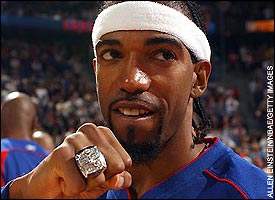
"Here's my ring, show 'em yours Scal"
5) Experience and veteran savvy. Rip has won a championship. He understands how things go in the playoffs. He understands how to draw fouls (and hopefully he can teach Derrick a trick or two in that department). Hamilton is also unselfish and he knows when to make the extra pass (which comes in handy on a very unselfish team like the Bulls). Many of these intangibles might not show up in the stat sheet, but they'll help the Bulls become a much more efficient team offensively, which is really their biggest issue.

Other than Rip Hamilton's impact there are a couple of other things that I think will work in the Bulls' favor this year. The first is Carlos Boozer. Last year was an absolute worst case scenario for Booze; literally everything went wrong, and yet the Bulls still got to the conference finals. I like how Bill Simmons' summed up the difference between Boozer last year compared to this year when he wrote:

"There were real reasons why [Boozer] stunk last year (new team, new situation, injured in training camp, not in the best shape, just never got it going, lost confidence) and real reasons why he'll shine this season (motivated and hungry, a 20/10 guy when healthy, better chemistry with Rose). He's too good to stink twice."

"King James ain't got sh#t on the White Mamba!"
The second thing working in the Bulls' favor is their insane depth. The starting five of Rose/Hamilton/Deng/Boozer/Noah is probably the most balanced starting 5 in the NBA, and they have Ronnie Brewer, Taj Gibson, Omer Asik, Kyle Korver, and CJ Watson coming off the bench. Those 5 bench guys would start on a lot of NBA teams. And I haven't even mentioned rookie Jimmy Butler or Brian "White Mamba" Scalabrine as designed high-fivers and towel wavers. Compare the Bulls bench to Miami's bench, consisting of guys like James Jones, Mike Miller, Eddies Curry and House, and you realize there is no comparison. I'll take our chances in Chicago with a fresh team coming out with consistent energy compared to Miami having to play their big 3 for 45 minutes per game. The depth will also help in this condensed regular season, with stretches of 7 games in 9 nights, or back-to-back-to-back games. Younger deeper teams will undoubtedly benefit from the grueling schedule.

Sure I'm probably riding optimistically high since the season is finally about to start, but it's fun and exciting to root for a team with great chemistry that's hellbent on winning, and I'm going to continue to expect big things from this group until they finally give me reason not to.

Monday, November 21, 2011

Ozzie Takes His Talents (and sacrifice bunts) to South Beach

August 31st, 2011. The White Sox still have about 30 games left on the schedule, and despite being 5 games behind the Detroit Tigers they were still very much in the AL Central race, thanks to a couple of head-to-head series with Detroit still on the docket. After Detroit won their game against the Royals earlier in the day, the Sox looked to keep pace by beating the Twins. With the tying run coming to the plate in the 9th inning, Ozzie Guillen pinch hit for Brent Lillibridge with Adam Dunn, and essentially made it clear that he had no intention, or desire to continue managing for the White Sox anymore.

It probably sounds like I'm being overly dramatic about one managerial decision, or that I'm a tunnel visioned fan who's looking for a person or moment to blame for a disappointing White Sox season (which is partially true). But this one decision, for a number of reasons, made it clear that Ozzie Guillen was no longer managing with the same competitive savvy he displayed in 2005. All good things must come to an end, and with everything that culminated into this one pinch hit decision, it became evident that it was time for Ozzie Guillen and the White Sox to part ways.

I don't want to sound like I'm dumping on Ozzie too much, because I still think he's a fantastic manager who's baseball knowledge and intuition is often overlooked because of his outlandish sound bytes. Here's why I still believe Ozzie is one of the top managers in the game today:

1) Ozzie is honest and blunt. He will let his players know how he feels and what their roles are, good or bad. It's important for direct communication to be open between players and coaches, and despite the fact that Ozzie's Spanglish is sometimes hard to understand, Ozzie made sure his players knew what was expected of them. It seems simple enough, but baseball players are creatures of habit who need to understand their roles, and how they're supposed to be utilized, and with Ozzie there was never any doubt.

2) Ozzie manages a pitching staff better than just about any manager in the game. His starting pitchers respect him because he always gives them a shot to earn a W. And Ozzie doesn't manage according to the save statistic. He knows who his best bullpen arms are, and he brings them in for the high leverage situations regardless of whether or not it will earn his "closer" a save. This was even evident as recently as this past year, when Ozzie did a masterful job of matching up his bullpen aces (Sale and Santos) in a manner that gave his team the best chance to win, instead of trying to pile up a bunch of saves for one player. Many managers are afraid to think outside the box and manage outside of the save rule.

3) Ozzie normally does a great job of keeping his teams loose and relaxed. He likes to have fun with the players, fans, and really anyone in the same room with him; he's kind of a fun loving guy. He also alleviated a lot of pressure from the 2005 World Championship team with his seemingly random rants and colorful sound bytes. Sure, Ozzie genuinely does like to complain about the god-awful facilities at Wrigley Field, or the double-standard that MLB presents by offering Japanese players interpreters, but not providing the same service for Latino players. But Ozzie's news-worthy rants served the purpose of taking the attention off of his players too. With a team that didn't feature a lot of vocal players (think Konerko, Dye, etc.) Ozzie assumed the role of the voice of the clubhouse so that his players didn't have to, and a lot of Ozzie's outbursts happened right around a losing streak to take the attention off of his teams recent failures. People assume Guillen is just a talkative guy who likes to randomly run his mouth, but the man is intelligent and knows what he's doing.

So where did Ozzie's relationship with the White Sox go wrong? Well, before we go back to August 31st, lets go back one month earlier, on July 30th. At this point in the season the Sox were barely staying afloat in the AL Central due in part to some issues in the back end of the bullpen in April (Matt Thorton couldn't close out games, and Juan Pierre forgot how to catch routine fly balls), but the biggest thing holding the White Sox back were historically bad performances from Alex Rios and Adam Dunn. The Sox were having a hard time overcoming getting absolutely nothing from two players who make over $10 million annually and were expected to be major run producers. Normally the front office (ahem...Kenny Williams) would be to blame for allocating such huge resources to players who not only don't produce, but come close to breaking MLB records of futility (Dunn would've had the lowest BA in history, but he ended up not getting enough ABs to qualify).

Kenny Williams saw that those two gaping holes in his lineup were killing the Sox chances at the post-season, and came out and made this statement on July 30th:

“We’re here to put the best players out there, who are going to fight the hardest, bust their tail the hardest, regardless of contract size, regardless of their history in the game, just play to win from here on out. That wasn’t a direct message at him, he is obviously the one most affected right now, but there may be others at any given time.”

The most important part of the statement is when Kenny says "regardless of contract size." This is essentially freeing Ozzie from the handcuffs of feeling like he has to start Dunn and Rios every day because they're making so much money. It's rare for front office types to admit their mistakes, swallow their pride and bench $25 million in salary, but Kenny did it in an attempt to save the White Sox season and to allow Ozzie to play Alejandro De Aza (freshly called up from AAA Charlotte) over Rios, and also to allow other hotter bats (like Lillibridge) to get some time in at DH while Dunn rides the bench.


It turns out that despite Dunn and Rios' hitting woes, the Sox had other solid options, as De Aza hit a home run in his first game with the southsiders, and provided an immediate spark with a quick bat, electric base running, and a sparkling glove, clearly out-performing Rios in every aspect of the game. Regardless of solid numbers in Charlotte against lefties and righties, Ozzie insisted on platooning De Aza, starting him only against northpaws while Rios continued to start in CF, play miserable defense, and hit weak ground balls to the shortstop. In addition to De Aza, Dayan Viciedo spent the first 5 months of the 2011 season absolutely mashing AAA pitching in Charlotte, and yet when he got called up to the majors he still found himself on the bench far too often while Adam Dunn continued to get at bats after 4 months of drawing standing ovations from an anxious US Cellular crowd for not striking out. This apathetic approach Ozzie had to setting his lineups was not something Sox fans were used to, Ozzie always preaches accountability, and was never shy about trying different lineups in the past to try to jump start the team. For some reason, Ozzie seemed resigned to watch the team continue to fail as opposed to trying to be proactive with his lineups to try to breathe some life into his team.


The last straw came on August 31st. Brent Lillibridge came to the plate against Joe Nathan, representing the tying run. Sox fans felt good, not only because Lillibridge had the hottest bat in the lineup and had homered earlier that afternoon, but also because "the Crusher" had homered off of Nathan in his only career at-bat against him less than a month earlier. Instead of allowing Brent to try to work his magic once again, Ozzie called for the discombobulated lefty, big Adam Dunn. I'm sure nobody was more surprised at the decision than Dunn. He gave Sox fans hope by working a 3-1 count, then, as he had done 156 times previously that season, he swung through two belt high fastballs right down the middle, and grabbed some bench. As if Dunn's confidence wasn't shaken enough, Ozzie brought him out once again in front of a huge crowd in a must win game, setting up what was certain failure based on what had happened that year. Kenny gave Ozzie the leeway to bench Dunn if he wanted, and Ozzie chose to further expose Dunn's miserable season in the most important moment of a must win game, essentially holding up a middle finger to Kenny Williams and Sox fans everywhere.

What was frustrating to me as a White Sox fan (and a fan of Ozzie) is that I know Guillen is capable of being a  very creative, innovative manager, and his competitive spirit has never allowed him to get lazy and stick with something that didn't work. For example, in 2005 Ozzie realized that he had issues with the back end of the bullpen when Shingo Takatsu and Dustin Hermanson didn't provide the consistency the Sox needed. The 2005 version of Ozzie wasn't afraid to call up an unproven rookie in Bobby Jenks, and when Jenks proved that he could produce, Ozzie trusted him to get the most important outs of the 2005 regular season, and eventually the final out securing the White Sox first World Series victory in 85 years. It was a combination of competitiveness, intuition, and sheer guts that allowed Ozzie to make bold moves like that, and unfortunately that version of Ozzie did not exist in 2011. There were options and opportunities for Guillen to try different lineups and bench certain players while giving more playing time to players like De Aza who earned the playing time with their production, and Ozzie did nothing. Pinch hitting Dunn for Lillibridge is the most glaring example of Ozzie not having the balls to do the unconventional thing that gave his team the best chance to win.


I still maintain that Ozzie is a great manager, and I have no doubt Miami will rejuvenate him, and baseball is a better sport with Guillen's fiery spirit and fantastic sound bytes around. And of course I will always appreciate the major role he played in bringing Chicago the only World Series victory any of us have seen in our lifetimes. But the relationship between Ozzie had grown stale, and sadly it's time to move on.

Monday, August 29, 2011

Oversaturation: OK For Sports, Not So Good for Sports Coverage

I really liked Cee Lo Green's Forget You. I'm not the only one, based on the 13 million hits the video has; and the video itself is especially entertaining with the Cee Lo and Gary Coleman love-child lip-syncing and acting out large portions of the song. The first time I heard the tune it stuck in my head because it was catchy, but in a good way, not in that annoying, "Lamb Chops" song kind of way. Somewhere between the 30th and 863rd time I heard the song though, my feelings changed. It was too much of the same, and I didn't care anymore. There was nothing new to the song, and the Cee Lo Coleman love-child didn't learn to juggle fire in the video or anything like that, so I became indifferent. It's not that I suddenly think the song is bad, I just don't care to hear about it any more.

It's rare that I experience this sort of apathy when it involves one of my favorite Chicago sports teams, but this is the way I've felt about the Bears for the past couple of weeks. It's not just that it's still the preseason for football; this stoic, passive feeling towards football will oftentimes strike me in the middle of a football season. Don't get me wrong, football is one of my favorite sports, and Sundays and Monday nights are always something to look forward to every week. Even the analysis on Mondays and Tuesdays are something I look forward too. But with one game a week, I can't stay interested in what's happening from Wednesday to Saturday during a football season (which is good because I certainly don't have the time anyways). That said, I most definitely can't make myself rehash the actions of millionaire athletes when the games don't even matter.

Don't look at me like that Roy, just catch the damn ball.
I felt compelled to write about my apathy (which is ironic enough) after the Bears lost to the NY Giants last Monday. For the next week, there was non-stop radio/blog/internet coverage about Roy Williams dropping a ball that got knocked out of his hands in the first quarter, and generally not showing enough effort. I'm not going to defend Roy Williams when he's sarcastic with the media, or for his failures in the earlier stages of his career, however I'm not gonna buy into the idea that one or two plays in meaningless games have any effect on the potential for Williams' season. First of all, Roy has been around the league for a few years, and there aren't any veterans who play all out in the preseason, because the most important thing is for players to stay healthy. Second, Roy Williams only makes $1.5 million on a one year contract; he's expendable. If he's not good or doesn't show enough effort, the Bears can cut his ass without any real financial repercussions (I wish the Sox could say the same about Alex Rios). But third and most importantly, a receiver having a bad game in preseason should not be the topic leading off every Chicago sports conversation for a week straight. We have two baseball teams in this city playing actual games, the one on the south side has an outside chance at the playoffs (I'm still holding onto a glimmer of hope for the White Sox), and the northsiders just fired their GM and will be rebuilding their front office soon. There's more than enough to talk about outside of football in this city.

Therein lies the issue with sports coverage pertaining to football. We live in the information age, where anyone can learn or find out whatever they want in an instant. Thanks to all of the access we have to any kind of information we want, our society has developed an issue with oversaturation, which has led to this information actually affected our society negatively. Oversaturation has manifested itself in a lot of different aspects of our life. Sometimes its hearing the same song too many damn times (sorry Cee Lo), but an even better example is the insane number of 24 hour news outlets we have in the US. Sure the news is important, but I don't think anyone is crazy enough to believe that there's enough worthy news stories to fill a 24 hour network. And I'm not just talking about one 24 hour news network, we've got FOX News, CNN, MSNBC, among others, and that's not even touching the surface of podcasts, or internet sites/blogs like Huffington Post.

Maybe I'm not "camera friendly." Maybe I do "eat my own dandruff"
So what happens when you need to fill 24 hours of news and you don't have enough stories? Well, you report extensively on things that aren't important. You can create storylines within stories that don't necessarily exist. You can serve up bold editorial comments/opinions on issues that serve as a way not to enlighten consumers and better our society, but more to make it interesting for the viewers so they keep coming back.

There is enough of an interest in sports that 'around the clock' sports networks can be easily supported; ESPN or sports radio are the best examples of this. These networks don't always have the same oversaturation issues as news networks though, because there's a lot of sports, and they have a responsibility to report on all the action. With baseball oversaturation is a non-issue because there really are enough games to support a 24 hour network during the baseball season. Remember, there's 162 games a year for 30 teams, which usually means about 6 games a week for 6 months. There's always a new game/story to talk about with baseball, because the games are happening every single day. This is one of the things I love about baseball, the large sample size allows you to find out who the really good teams/players are without worrying about whether it was a fluke.

Football is different. We have an avalanche of games on Sunday, then those games are talked about, dissected, analyzed, re-dissected, regurgitated, and analyzed once more, and then Wednesday rolls around and the networks essentially rinse, and repeat. Despite the fewer number of games, any network will admit that they spend the majority of their time/resources on football because it's the most popular sport in America, and that seems pretty fair for a business in a capitalist society. It is obviously flawed though, when football, a sport that has 16 games a year gets more coverage than baseball, a game that has 162 games a year. There's just not enough to talk about every week because there's not enough games. So sports fans end up enduring analysts griping for days/weeks at a time about how Roy Williams dropped a pass in a game that didn't count. This is not an indictment on football, I still love the game, right up there with baseball and basketball, there's just far too much analysis for me, and I know that the 2 weeks before the Super Bowl happens are gonna annoy the crap out of me like they do every year, with so much analyzing and predicting without anything actually happening for 2 weeks.

I can promise you every Sunday my DVR will be fired up and I'll be genuinely excited to watch my Bears play. I'll even read Gregg Easterbrook's TMQ (Tuesday Morning Quarterback) article on ESPN on Tuesday. But as for the entire preseason coverage and rehashing of the week's games on Wednesday through Saturday, I think Cee Lo summed up my thoughts when he said "Forget you and f@#$ you too."

Sunday, July 31, 2011

"Ev'ry Time We Say Goodbye (I die a little)... So Long Olin Kreutz

After 13 years of snapping the ball for the Chicago Bears offense, Olin Kreutz is considering retirement after rejecting the Bears 1 year offer of $4 million ($2 million less than he made last year). Olin wasn't just a consistent starting center for the Bears, he was also the offensive line playcaller, and the primary leader of the team's offense over the past decade. He was respected and revered in the Bears locker room for his leadership abilities and his overall toughness, playing in more games (183) than any Bear in history not named Walter Payton (184), and the move obviously didn't go over extremely well in the Bears locker room. Bears safety and prolific tweeter Chris Harris summed up the overall feeling among Kreutz's former teammates by tweeting "Olin Kreutz departure won't sit well in the locker room for a few days #realtalk" and "In my 7 yr NFL career Olin Kreutz is the toughest player I have EVER played with #PERIOD"

I think a lot of Bears fans will share similar sentiments, fans have always loved Olin because as Bears guard stated, "He stands for what a Chicago Bear is. Tough. Hard-nosed football player. He made his teammates better." Bears fans love those tough players who will grind it out and play through pain, and this same rationale contributes to the reason that Jay Cutler is generally disliked in Chicago after he wouldn't play through a torn ligament in the NFC Championship game last year. The problem with this rationale is that it overlooks the talent of the player in question. I've always loved Kreutz because he's consistent and fans, coaches, and front office workers have known what to expect from Olin for the last decade. The problem is that the 34 year-old Kreutz has 13 years of NFL mileage on him, and he's not getting any younger or quicker, and primary goals of the Chicago Bears shouldn't be to be the most loyal team in the league, but to win as many championships as possible.

There are times when a player's performance and contributions to a franchise cannot be overlooked, and those players need to be rewarded even if their skills are declining. A couple examples of this idea working out in the proper manner are Derek Jeter's most recent large contract, or more locally, the White Sox continuing to reward Paul Konerko for what he's done for the Sox franchise (fortunately Paulie continues to produce regardless of age). One example of this concept being completely mismanaged is the way Frank Thomas and the White Sox parted ways. Unfortunately Olin Kreutz does not reside in the class of the 3 athletes I mentioned. I will always appreciate Olin's consistency and toughness that he brought to the Bears franchise for 13 years, however his shortcomings shouldn't be overlooked, and the certainly shouldn't cloud the judgement of the front office and prompt them to reward Olin with a crippling franchise. While Jerry Angelo and the Bears front office make a lot of questionable decisions, cutting ties with Olin was not one of them.

Olin was ranked 33rd last year in terms of efficiency among NFL centers according to profootballtalk.com (meaning a backup performed better than he did). Olin called the shots for a historically bad offensive line that allowed their quarterback to get sacked 9 times in a half against the Giants. The offensive line that was supposed to protect Jay Cutler allowed Cutler to get sacked 52 times in 15 games, and the beating that Jay took contributed to his injury that directly affected the Bears exit from the season in the NFC Championship Game against the Packers. Kreutz also allegedly complained about snapping the ball out of a shotgun formation during his tenure with the Bears, limiting their playcalling ability. The Bears never won a Superbowl with Olin manning center and acting as the locker room leader. With all of these things in mind, it was time for the Bears and Kreutz to part ways, and while I wish Olin the best, I was happy to see the Bears agree to terms with former Seahawks center Chris Spencer.

This whole scenario made me question what it takes for a player to essentially gain tenure; what does a player need to do to earn a comfortable contract and the right to play until he decides to hang it up, even if he's a bit past his prime? To me it boils down to a combination of 3 factors:

1. Performance - Obviously a player's performance is paramount to how that player should be received and respected, and it's no different than any profession; if you're reliably good at your job over a long period of time, you will be respected and should be rewarded. Frank Thomas is a great example of this factor, he turned in 16 phenomenal years with the Chicago White Sox and is one of 8 players with 500 career home runs and a career batting average over .300, and he's the 11th player to win back to back MVPs. His performance, among other contributions to the franchise, should have earned him the right to play with the White Sox however long he wanted, at a reasonable salary. Unfortunately things didn't go this way with Thomas, as he and GM Kenny Williams exchanged harsh words before the Big Hurt left for the Oakland A's, and when Thomas said he didn't like how his 16-year run with the Sox ended, Williams fired back by calling Thomas an "idiot." Thomas naturally went on to finish 4th in the AL MVP voting in 2006 with Oakland, but fortunately relations between Frank and the Sox have been mended, as the White Sox unveiled a statue in honor of the Big Hurt on Sunday, but because there never should have been those issues with the performance that Thomas brought to the south side for 16 years.

2. Contribution to the Franchise- This one is a little more vague, but still pretty easy to calculate with a little thought. If you ask yourself "How would this franchise be affected if the player in question never played for this franchise?" and you determine that the franchise would be drastically affected, it's probably a good indicator. For example, Paul Konerko has been the face of the Sox franchise for a decade now as a consistent leader (similar to Kreutz), but Paulie has also backed it up with his performance, and has led the Bears to a World Series and multiple divisional championships/playoff appearances.

2 Guys in the 3k hit club. Glad I found this pic.
3. Championships - This is far and away the most important factor. Paulie gained some slack when he led toe White Sox to a World Series title in 2005, but the best example of this factor is Derek Jeter. Despite the opinion of any scout or sabermatrician that Jeter's skills are significantly declining in the last few years, he was awarded with a 3-year $51 million dollar contract, and it was justified. Jeter has captained 5 different World Championship teams for the Yankees. Enough said.

When you factor in Jeter's performance (3,000 hits, 5 Gold Gloves, one of the most clutch performers in the history of the game), his contribution to the franchise (the captain and face of the Yankees for the last 15 years, in addition to being a model citizen and role model), in addition to the 5 championships, the Yankees did the right thing by overpaying to keep Jeter; the man earned it. Olin Kreutz has meant a lot to the Bears for the last 13 years. However, he hasn't brought any championships to Chicago, and the performance has been not been up to par the last few years. Meatloaf once sang "2 out of 3 ain't bad," but 1 out of 3 won't cut it Olin. Bears fans wish you the best in the future and appreciate your contributions, but it's time to move on.

Monday, July 11, 2011

Aurametrics: Can Musicians be Quantified?

I love baseball. There's so much to love. It combines the athletic abilities of running, throwing, catching, and intricate applications of hand-eye coordination with a cerebral, strategic mind-game that fluctuates from pitch to pitch. Baseball is a sport where excellence is not limited to the physically gifted; there are no height requirements like in basketball, or weight/strength requirements like in football, but as Hawk Harrelson consistently reminds us, "it takes all shapes and sizes to play this game." The uniqueness of baseball doesn't end there, as Ken Burns likes to point out in his documentary and in interviews, baseball is one of the only sports in which the defense controls the ball, and the majority of the action. It is also exclusive to baseball that the players, not the ball, accumulate points (or runs). Not to mention that, like any sport, baseball has a rigid set of rules, however, unlike other sports the actual dimensions of the playing field vary based on the city or stadium in which the game is being played.

None of these fascinating characteristics accurately describes why baseball is my favorite sport though. I will continually be riveted by baseball because it is the ultimate team game, yet it is made up of a series of individual encounters, or "battles" as Jeremy from Sports Night would say. Every play starts with a "battle" between one pitcher and one batter, and what happens next is almost completely determined by the skill of those two individuals. Despite the individuality of this encounter, baseball truly is the ultimate team sport because a batter is only allowed to hit once through a lineup, which results in about 4 or 5 at-bats per game. It's not like basketball where you can go to your best player on the most important crunch time plays, or like football where you can feed the ball to your star RB or throw a fade to your monster WR. I'm sure Tony LaRussa would love to send Albert Pujols up to the plate in every important scenario, hell, I'm sure he'd like Albert to take every at-bat, but baseball doesn't work that way. However, since we have so many individual encounters, statisticians are able to quantify the sport more than any other.

With the technology used these days, we are able to track the usefulness (or lack thereof) of literally every action on a baseball field. Sure, advancements are still being made to analyze fielding (though the UZR and DRS systems are a pretty solid indicator with a large enough sample size), or pitching, but anything a hitter does can be tracked, counted and analyzed to a point that doesn't exist in any other sport. Surf around the Fangraphs glossary sometime, especially the offensive statistics or miscellaneous statistics and you'll find a maniacal thoroughness in their newly invented statistics: http://www.fangraphs.com/library/ Some might find this sort of analysis boring, but personally I love numbers, and I love being able to figure out why or how things happen. This sort of analysis is like brain food for me, it's enthralling and satisfying all at once, and it supplements my love of a game that I already appreciated anyways.

So what does this have to do with the title of this blog? Well, as I mentioned in my inaugural blog post, I'm a professional piano player, and I was playing for a wedding this past weekend. I love playing weddings or parties, or any kind of celebration because everyone is always in a good mood and happy to be there, not to mention that there's always free food and usually an open bar. I'm completely accustomed to people coming up to me after I play at the event and giving general compliments like "great job!" or "the music was beautiful!" to the point that I'm kind of numb to it. I mean, it is my profession, and I take my playing seriously so I practice and prepare so that I will sound good, the same way that I'm sure these people are thorough with any job that they're being compensated for. The difference is that as the song "There's No Business Like Show Business" states:

"The butcher, the baker, the grocer, the clerk
Are secretly unhappy men because
The butcher, the baker, the grocer, the clerk
Get paid for what they do but no applause."

There was one older gentleman however who came up to me and said "I heard you hit a wrong note in there. But you did a beautiful job, everything else was real smooth."

Don't get me wrong, I'm not upset with this man because I always appreciate honesty, and I'm admittedly bored with the same compliments, not to mention I know that I play several wrong notes any time I sit down at the piano and play for a while, almost all of which I assume are unnoticeable to the untrained ear. But his statement got me thinking, Which note was he thinking of? How many notes did I miss, was this the only one? When I perform, what percentage of notes do I miss? What percentage of my mistakes are noticeable to an untrained musician? and lastly, and probably most importantly, Would this ever be worth quantifying?

I realize that this is the exact line of thinking that Bill James had at some point when he pioneered the sabermetrics movement in baseball. I'm sure these kind of thoughts popped into Voros McCracken's head when he developed his DIPS theory. http://en.wikipedia.org/wiki/Defense_independent_pitching_statistics The problem is, I don't believe the technology exists (nor do I feel it necessary to devote the time) to gather the information needed to calculate these things, unless someone wants to develop whatever electronic sensors Bugs Bunny used to have when teaching piano lessons (and the student would get electrocuted if he played a wrong note). But, if the technology existed to make aurametrics (a word I made up today meaning the analysis of music through objective, empirical evidence) possible, here are the stats (that I also just invented) I'd be intrigued to analyze:

Note Percentage (NP): This would be very similar to fielding percentage (FP), it's just the percent of notes that are hit correctly. In baseball, a solid FP is around .985 to .995 (or 98.5% to 99.5%), and I'd like to think that professional musicians are in that ballpark (pardon the pun), so out of every thousand notes I'm playing, I'm missing 5-15 of them. Sounds about right, on a good day at least. But similar to FP in baseball, NP could be a misleading stat. FP is deceiving because errors can be misleading since they don't factor in things like defensive range, and the importance of the errors isn't weighted. The latter is the biggest issue with NP, the importance of the missed note isn't weighted. Some missed notes are greater offenses because they're more obvious to an untrained ear than a minor mistake that most wouldn't notice, for example the note that I missed that provoked the old man at the wedding to mention it to me. This would prompt aurametricians to come up with the following stat:

Discernible Note Percentage (DNP): Different than a DNP in sports (did not play), this stat works the same way NP does, except it doesn't measure the actual missed notes, but the number of missed notes that the listener notices. It's more useful than straight NP since the only mistakes that matter are the ones that actually affect the listening experience, but this varies from listener to listener. This variance presents aurametricians with the issue of coming up with a consistent baseline of listeners, a constant test group to compare data against, which leads to the next concept:

Replacement Listener (RL): Based on the idea of a replacement player in baseball, which is a theoretical player who can be signed to the league minimum contract and will perform at that level (i.e. about as good as the best minor league AAA players would perform in the majors). Here's more info about the replacement player compliments of fangraphs: http://www.fangraphs.com/library/index.php/misc/war/replacement-level/ A replacement listener would have the average musical acumen of someone with no musical training, and would have to be calculated through an absurd number of aural tests for average people who have had no musical training. This baseline would lead us to statistics like this:

Discernible Replacement Listener Note Percentage (DRLNP): If I'm playing a Chopin waltz, and my fiance is present, she will be fully aware if I make any mistakes, because she's a professional pianist as well, and much more proficient with classical music than I am, so her discernible note percentage for me will be much lower than probably anyone else in attendance, and therefore not a great indicator of the importance of an error in relation to the average listener. That's why DRLNP would be so important, because some mistakes are inconsequential (like an error where there runner doesn't even end up scoring in a 12 run blowout), but some mistakes are obvious and important. This statistic would accurately reflect the mistakes that I make that would be obvious to anyone even if they don't have any musical training at all (our RLs).

If we're taking into account the importance of a given missed note, it's probably also important to take into account the importance of the situation of the performance too. Like comparing a baseball player's spring training stats to their regular season stats, or their regular season stats to their postseason stats. So here's a few more NP-based statistics:

Practice Note Percentage (PNP): The NP of notes played while practicing, or more specifically, not in front of a live audience.

Live Note Percentage (LNP): The NP of notes played in a performance in front of a live audience.

Of course we can apply these statistics to our replacement listener as we did earlier, giving us the following stats:

Discernible Replacement Listener Practice Note Percentage (DRL-PNP): Just calculating the DRLNP in practice situations.

Discernible Replacement Listener Live Note Percentage (DRL-LNP): Calculating the DRLNP in a live, performance situation.

Using these stats we can see how well a musician can deal with nerves, or how well they perform in a live performance situation. Translated into sports, these stats give us a good feel for how "clutch" a musician is. How else could we determine who the Derek Jeter of music is? World-renowned jazz guitarist Bobby Broom once told me (and I'm paraphrasing) that a musician will probably play to about 80% of his ability in front of a live audience compared to the 100% of his ability that this musician plays at in a practice room, mostly due to nerves. He had no statistics to back this up obviously, because the point was that any musician (or athlete for that matter) needs to over-prepare to be ready to deal with the nerves of a live situation, a circumstance that is difficult to simulate. If aurametricians are able to compile the data needed someday, we'll be able to actually calculate the effects of nerves more precisely, but with this information we could still calculate a pretty fascinating ratio to see which musicians deal with their nerves the best. Here's my final (and most interesting) statistic of the post:

Clutch Note Percentage Ratio (CNPR): Calculated by dividing Discernible Replacement Listener Live Note Percentage by Discernible Replacement Listener Practice Note Percentage (DRL-LNP/DRL-PNP): The hyphens are not subtraction signs, they're just there to make the six-letter stat names easier to read. Obviously the actual names or abbreviations of the stats might need some work since they have a lot of letters and are lacking the convenient abbreviation with a cool ring to it, like VORP or WAR (again, check the fangraphs glossary if you wanna know what VORP or WAR are). For the purpose of simplicity, I'm going to call this stat Clutch Note Percentage Ratio (CNPR) until I come up with a better name for the stat, or until a better one is suggested. 

The name is not strong, but I believe the premise is. This stat separates the important mistakes from the inconsequential ones through the application of our Replacement Listener, and allows us to analyze which musicians are able to perform best when it counts (in a live setting). A CNPR of 1 means the musician performs with the exact same acuity whether practicing or performing. The higher the CNRP is, the more "clutch" (or accurate in live settings) a musician is when it counts. If the number is lower, it means the musician is unable to play up to his/her abilities in live situations, which can be most likely attributed to nerves. I would imagine CNPR of higher than 1 would be rare, as most musicians don't play better when the spotlight is on them, but it would be fascinating to find out. Now, if anyone has any ideas on how to compile the data, I'm all ears...

Friday, July 1, 2011

Talking Box Scores with Rain Man

I'm told that I have certain obsessive compulsive tendencies. Not anything that affects my life too abnormally, but just certain mundane habits and routines that have spawned from my analytical approach to basic tasks, and my love of numbers and routine. For example, I tap my contact case a specific number of times before putting in my contacts (7), I count stairs as I walk up and down them, and I run my toothbrush under running water a certain number times (3 sets of 7 under warm water to soften the bristles, then 7 more times under cold water after the toothpaste is applied).

None of this is interesting to anyone I'm sure, and none of this has anything to do with sports. However, my habit of scanning the box scores of every MLB game every night is a bi-product of my love of numbers and routine, and I believe this particular habit is not just a mundane, slightly obsessive compulsive act. My box score analyzing illustrates all of the action of my favorite sport through numbers, increases my baseball acumen by supplementing the games I'm able to watch, and ultimately enriches my enjoyment of the game.

Enjoying a game that includes such a great visual aesthetic through numbers might not make sense to some, but today I'm fortunate enough to chat with a gentleman who understands what I'm talking about, Mr. Raymond Babbit (more commonly known as Rain Man). I'm joining Ray today at the Walbrook Institute in Los Angeles, and he seems to be receptive to my company, as his brother Tom Cruis... er, Charlie Babbit is busy studying the history of psychiatry, or postpartum depression, or something like that: http://www.youtube.com/watch?v=HwAaHbmF5S4

Always double down on 11! Wait, wrong movie.
Anyways, let's bring Ray in on the conversation. Here we go:

Scott Williams: Hi Ray, great to finally meet you, you're movie Rain Man is one of my favorites of all time.

Raymond Babbit: S-C-O-T-T. My main man.

SW: Ray, I seem to recall you're excellent with numbers, based on your ability to memorize large sections of phone books and count cards with your brother in Vegas.

RB: Definitely. Counting cards in Vegas, def.. definitely counting cards in Vegas.

SW: And you're a Dodgers fan right?

RB: Yeah. Go see the Dodgers play. Today's an off day.

SW: I just remember you getting excited about the thought of seeing Fernando Valenzuela pitch.

RB: He pitched Saturday. Not scheduled to pitch till Wednesday.

SW: I'm pretty sure Fernando is retired, but I think he's a Spanish color commentator for Dodgers games within the NL West. Maybe we could go see Clayton Kershaw pitch, he's been Valenzuela-esque, with one of the highest strikeout rates in the league.

RB: Kershaw pitched Wednesday, Ted Lilly scheduled to pitch today.

SW: Eww Ted Lilly.... you're right, we might as well stay home. Well when's Kershaw pitching next?

RB: Next scheduled start in Los Angeles, Thursday July 7 against the New York Mets. Jose Reyes and K-Rod.

SW: Ooh, Reyes is having an MVP caliber season this year with 15 triples through 78 games already, but I'll let you in on a secret Ray, K-Rod sucks. I hate that stupid dance he does every time he records a save, and he beat up his girlfriend's dad last year, which is certainly not something that Second City Chin Music endorses. Anyways, I wanted to talk about how useful box scores can be for fans who wanna stay up to date with what's happening in the MLB, cause it's hard to keep track of all of the games at once. I mean, there's usually 15 games a night right?

RB: (looking at the sky) Yeah. Yeah, 15 games, 135 total innings, 810 outs.

SW: That sounds about right, and that's without extra innings! So if the average baseball game lasts 3 hours, and each team throws an average of 145 pitches per game, than how many pitches are we looking at in a given day?

RB: Yeah. 6 minutes to Wapner.

SW: Ok, I know, I was just curious.

RB: (rocking back and forth) 45 hours, 1 day 21 hours worth of baseball every day. About 4,350 pitches per day... Definitely 4350 pitches....... of course, there's 5 minutes to Wapner.

SW: Can you imagine someone trying to watch every minute of every game? Even if you had 5 TVs, and another game blasting on the radio...

RB: 97X...BAM! The future of rock and roll! 97X........BAM! The future of rock and roll! 97X..........BAM The fut....

SW: Alright Ray, go watch Judge Wapner before I have to take up residency at the Walbrook Institute too.

Anyways, there's some unique things to look for when you're looking at box scores, certain patterns to look for, and an interesting aesthetic value to the visual of how certain performances translate to how the box score looks. This idea has been adapted by former Ohio State basketball walk-on Mark "Club Trillion" Titus, who got his nickname based completely on his standard box score. Since Mark typically entered games in the last minute of blowouts (like Brian "the White Mamba" Scalabrine), and didn't contribute any statistic to the game (no points, rebs, turnovers, etc.) his box score read across like the number one trillion: 1 0 0 0 0 0 0 0 0 0 0 0 0 (the number 1 being in the minutes category which is listed first). Mark's blog is great, and I'm following it so you can find it in my profile, but this hilarious video is my favorite thing he's ever put out, and is well worth a watch: http://www.youtube.com/watch?v=5V6FCitvRUM

Most avid baseball fans try to keep up with all of the activity throughout the league, and normally fans will rely on the highlights they see on ESPN or online. Highlights are great, but you completely miss out on the nuance of the game by only watching highlights. You might see a go-ahead 2 out 3-run HR on ESPN, but maybe you miss out on a couple of clutch 2 out hits to set up the 3-run bomb. And you won't likely see highlights of a dominant save, or a relief pitcher getting out of a jam. All of these storylines can be found withing the confines of box scores if you know where to look: you can tell how much a pitcher was laboring by checking his pitch count, how much an offense struggled with men on base by checking the LOB stat (or a couple of my favorites, the 2-out RISP or 2-out RBI stats). Extra base hits are easily accounted for in box scores, and the often elusive HBP and errors (elusive since HBPs don't count as an at-bat, but a "reached on error" is counted as an out) can be spotted pretty easily too. The point is, box scores can tell the full story about the events of a game in a way that highlights will never be able to. In a sport where a series of individual battles culminate into the ultimate team sport, the way we analyze the skills of the individual players becomes even more essential to understanding the game. This is why sabermetric analysis has been more vital for understanding baseball than any other sport, like basketball or football for example, where the events that take place are much more dependent on context and personnel than on individual ability. The fact that baseball can be so much more precisely measured and quantified than other sport is what makes box scores so relevant and fascinating to me.

ESPN's Jayson Stark is another writer who scans box scores for fascinating lines that will jump out (like when Vin Mazzaro gave up 14ER in 2.1 IP), and for storylines like that I like to check for the crooked numbers, more specifically, who got multiple hits/RBIs/runs scored, etc. They're easy to find with a quick scan through the page as the majority of the numbers in box scores end up being 0 or 1. Also, the box scores keep you in touch with manager tendencies; you can quickly detect batting order changes, and you also get acquainted with how a manager uses his bullpen. There are certain types of lines that jump off of the page, the same way certain performances will be more memorable, like if a hitter has more than one 1 hit, RBI, and run scored (lots of crooked numbers), or if a pitcher has significantly more Ks per IP, or significantly less walks+hits compared to IP. One of these days I'll come up with names for certain box score lines to distinguish them, but that's a blog for another time, especially since Wapner is finishing up. Let's wrap things up with Ray real quick.
I can't tell if this picture was taken in 1985 or yesterday.

SW: Hey Ray, looks like Wheel of Fortune just started.

RB: Wheel Of Fortune. Look at the studio filled with glamorous merchandise. Fabulous and exciting bonus prizes. Thousands of dollars in cash. Over $150,000 just waiting to be won as we present our big bonanza of cash on Wheel. Of. Fortune.

SW: Yup, I just can't believe that Pat Sajak and Vanna White refuse to age. Anyways, let's look into tickets for that Dodgers game, about how much are tickets at Chavez Ravine?

RB: About $100.

SW: Well we don't need to get box tickets or anything, what about just some bleacher tickets and we can move up if there's empty seats?

RB: About $100.

SW: Ah yes, you're not into the whole "money" thing. Well are you still excited about seeing Jose Reyes and K-Rod?

RB: K-Rod sucks.

SW: Oh, I see.

Wednesday, June 29, 2011

Sports: Reality TV for Dudes?

It's undeniable that reality television has become a significant part of all of our lives. We all fall into two categories with reality TV: the people who perpetuate the craze by watching and discussing shows like Jersey Shore, the Bachelorette, and any of the Real Housewives franchises at length, and the people who deal with all of the conversation, but are confused by the general public's fascination with all of it. I fall into the latter category. Unfortunately, as other people who fall into this second apathetic category can attest, we can't completely avoid learning about these shows, they're such a huge part of pop culture that we're expected to at least be familiar with the characters and general story lines, the same way people are expected to be aware of the Harry Potter or Twilight franchises, whether we've read the books or not.

Oh Ashley, you can do so much better than Bentley.
These characters, who are especially unique because they have no discernible talent or characteristic other than the willingness to allow their lives to be filmed, pop up everywhere in our lives. Sometimes you might hear Stacey King or the Funkenstein make a reference to Scottie Pippen's wife's participation in the Real Housewives of Miami. Or maybe you're watching a roast of Donald Trump on Comedy Central and you have to endure one of the worst "comedic" flops of all time when, for some inexplicable reason, Jersey Shore's "the Situation" is asked to speak: http://www.youtube.com/watch?v=LEx3mYck-2c (Ice T's reaction around the 3:20 mark is priceless). Reality television has become such a integral part of our lives, we've spawned movies like EDtv and the Truman Show which are entirely about characters who's lives are documented in the form of a reality show. As I was "watching" the most recent episode of the Bachelorette with my girlfriend (by "watching" I mean checking baseball box scores on my computer and then glancing at the show when someone starts yelling, cursing, or hooking up), I started thinking about our society, and the type of people that really enjoy these shows, and why.

Of course, the process of analyzing the types of people who like or dislike reality shows went down a road of generalizing and over-simplification, but I still came to some reasonable conclusions that are backed up by the people I know and the experiences I've had. It's a small sample size, I know, but think of it more as my own case study.

Here it goes: I think it's fair to say that the majority of reality shows are geared towards women. This is obvious with the Real Housewives franchise, but I think it's safe to say that most of the dating/relationship reality shows fit this category too; generally speaking, women are more fascinated with romance, and the fact that it's real (or as real or unscripted/edited as anyone can believe reality shows to be) makes it infinitely more interesting than a romantic comedy with a predictable ending. This idea is manifested in shows like The Bachelor/Bachelorette, Blind Date, Cheaters, The Fifth Wheel, and Elimidate (side note: I am an exception to my own generalization, Elimadate was a fantastically trashy show, I absolutely loved it). Sure there are many other reality shows that generally appeal to men and women, like Survivor, or Jersey Shore, and while I haven't done the demographic research or taken any polls, I feel confident that, generally speaking, women are consuming more reality television than men, mostly due to the subject content of the reality shows.

Where the enjoyment comes from with these shows is pretty clear; there's a cast of characters that viewers can identify with, and the more viewers watch them, the more they get used to their characteristics and idiosyncrasies. Viewers can see a little of themselves in certain characters, and a little of their friends or foes through the actions of other, less desirable characters. Viewers root for the characters they like and identify with, and the entertainment value comes from how they interact with the other characters, especially the ones they don't like. Even though viewers of reality shows aren't naive and would never feel like their actions or thoughts truly affect anything happening in the show, the fact that they identify with certain characters allows viewers to really feel like they are a part of the show. Since these programs are (allegedly) unscripted, it creates a different type of tension for the viewer and makes them feel like a part of what's happening, as they can see how the characters that they're familiar with adapt to certain scenarios, and compare that to how they might have reacted.

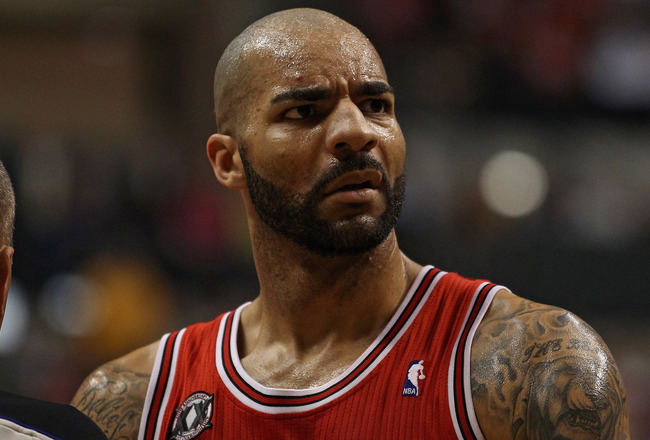
I'm confused too Carlos. Where's the 20-10s you put up in Utah?
Male sports fans enjoy this kind of entertainment every day; this void in their life is already filled. Read the previous paragraph and replace the word viewer with fan, the word character with player, and the word program or show with game. The enjoyment derived is exactly the same, only the medium is a ballgame instead of a reality TV episode. I watched all 98 Bulls games this year (mostly on DVR, with a lot of fast-forwarding to the 4th quarter), but as the season progressed, it was essentially a reality show for me and the way the players (characters) of the league developed was completely enthralling. The maturation process of league MVP Derrick Rose was incredibly satisfying, as he did it with a combination of humility, while stepping up in the most important moments and oftentimes willing his team to victory during the regular season. Luol Deng stepped up in a big way and played up to his contract value for the first time this year with his newly developed 3pt shot and his suffocating defense, and I could always look forward to some energy plays and craziness from Joakim Noah. The bench mob was always fascinating as they brought an exuberance that you don't see from most benches in the NBA, and the starters fed off of their intensity. I rooted for Boozer to perform the way he did in Utah all year, and whether he was injured or just getting older, his issues throughout the season provided an intriguing (and frustrating) subplot to the season. All of this is without even mentioning the clear cut villains the Bulls were competing against in the Eastern Conference: the mighty Celtics who ousted the Bulls in the greatest first round series in the history of the sport 2 years ago, and obviously the Big 3 in Miami; after both LeBron and Wade turned a cold shoulder to the Bulls in the offseason in order to join forces and try to start a dynasty in South Beach.

The point is, when a fan follows a team, he/she gets familiar with the players, and what happens with that team becomes a part of their life. My girlfriend sets the DVR to record the Bachelorette episodes, and will carve out time every week to sit down and enjoy them, because she looks forward to seeing what Ashley is gonna do next. Will she finally come to her senses and throw Bentley out on his ass? Who knows? But in the exact same way, when the NBA lockout ends and the next Bulls season starts, I'll be sure to set the DVR and sit back, relax, and strap it down while enjoying the sounds of Stacey King and Neil Funkenstein narrating DRose and the Bulls' next chapter. Can Rose win back to back MVPs? Will Chicago be able to find a ball-handling 2 guard who can help them get past Miami? Do the Bulls have a shot to win their first title since Michael Jeffrey Jordan graced the starting lineup? Who knows? All I know is that I can't wait for next season.

Monday, June 27, 2011

Hello Blogosphere!

With my first post on my first blog, I'd like to say hello and thank everyone reading; I can assume that if you're taking the time to peruse a blog currently titled "Chicago Sports Blog" (working title for now) than I'll go out on a limb and assume we have similar interests, and going out on a branch on that limb, I'll assume that I like you already. This blog is mostly acting as my own catharsis as I, like many, invest waaaaaay too much time and emotion into sports, but I, like many, can't help it. Playing sports and following professional sports shaped my life as I grew up, sports created new friendships, and sharing the love of sports with friends and family has served as a bonding experience and has helped foster many of the important relationships in my life, so to those of you who will say "it's silly to invest so much time and energy following athletes who make millions of dollars and don't give a shit about you and your life," I'll say 2 things: 1) you are 100% correct, and 2) fuck off - it matters to me.

Hopefully you, and others out there are like me and love discussing your favorite Chicago sports teams, but don't have the right venue to do so, and you're fully aware that your girlfriend/wife/sibling/parent/dog/friend/co-worker/significant other etc. does not want to hear you bitch about where Adam Dunn should hit in the Sox lineup. If any of that remotely hit home, than this blog is for you, and feel free to utilize the comments section, whether you agree with my ideas or want to give me props, or if you vehemently disagree with me and want to tell me how much I suck. I'm always open to chat/debate, I just ask that you try to not me too disrespectful to anyone, and if you want to make an argument, at least do your homework and back up your thoughts, I'll do my best to do the same.

I'd like to use the rest of my inaugural post to talk a little bit about my background, so you have an idea of where my thoughts are coming from (don't worry, this is a sports blog, and this will be the only time I talk about myself at any length). I'm a 25 year-old professional piano player living in Chicago (surprise), and I was born in Pontiac, IL and grew up in Naperville, a southwest suburb of Chicago. My favorite sports are baseball, basketball, and football (in that order), and while I like hockey and appreciate and respect the players more than any other sport, I never got into it when I was younger because I cannot rollerblade, rollerskate, or ice skate (you might say I was not blessed with foot-eye coordination, and that would be an understatement). The lack of foot-eye coordination is just a grain of sand on the beach of reasons why I hate soccer, and is also why soccer will not be discussed at length on this blog (unless I decide to make a post detailing another reason why soccer is a waste of time).

I played quite a bit of baseball and basketball when I was younger, but when I reached high school, I was in a class of almost 1000s students, so everything was very competitive, and students had to specialize. I knew I wanted to be a musician someday, so that's where my organized baseball and basketball playing stopped. I still miss playing baseball, and try to make up for it by taking advantage of any opportunity to play softball I can (12in or 16in, I'm down either way). High school was probably a good time for me to quit basketball as, well, since I'm 5'10'' on my tippy-toes, and I have what my friends referred to as credit card hops (you can barely slide a credit card under my feet when I jump). I could shoot though, and I'll still challenge anyone to a free-throw shooting contest or 3pt shooting contest (with my ugly set shot), not to mention, like Carlos Boozer I can finish with either hand (that's what she said).

"That's a big man." -Hawk Harrelson
The White Sox are my team. My dad was a Sox fan, yet he was an equal opportunity father, and brought me to both Comiskey and Wrigley when I was young. But I fell in love with the White Sox of the '90s, and who could blame me? I had an irrational love of Bobby Thigpen, who legitimized my feelings with his record setting 57 saves in 1990, and I loved listening to Tom "Wimpy" Paciorek and Ken "Hawk" Harrelson; it's not easy making anything fun for 3 hours when your 7 years old, but Wimpy and Hawk made baseball fun for me. More importantly than any of that, the Sox had '93 and '94 MVP Frank Thomas. Now that I'm older I can look back at his stats and really appreciate what he accomplished in the '90s, but as a 7 year-old it was so fascinating to watch a physical specimen like him (6'5'' 300lbs of pure muscle)  tower over all the other players and dominate the league. Even his awkward throwing motion was frightening (you know, back when he still played 1b and left the DH spot to the likes of Julio Franco). Hawk's nickname of the Big Hurt was perfect, you felt bad for the baseball (and the pitcher's pride) when Frank connected. In his prime you couldn't get him out, there was no way to pitch him. Pitch him away and he'll get to extend his long arms and really cremate the ball to dead center or right center (and he could still pull the ball on the outer half if he wanted, the same way Jose Bautista does today). Pitch him off the plate outside and his ass would fly towards the 3b dugout while reaching out and poking a double down the right field line. Bust him inside and the hips would fly open and you'd be watching a majestic 400 footer sail deep into the left field seats, sometimes approaching the concourse at Comiskey. He was awesome, and a big reason that I'll be a die-hard Sox fan for the rest of my life.

It's not hard to explain where my love for the Bulls came from, we had Michael. If anything, the Bulls of the '90s spoiled sports for me, because when you watch your favorite team, and you know that they're gonna win the championship every year, you learn to develop unrealistic expectations for sports teams, which is bad at a young age. But that's what Michael was, one of the few athletes in the history of sports who had the combination of talent and desire that was absolutely unmatched by anyone, once he got surrounded with Pippen and a few role players, it was all over, and the basketball world got to witness some of the greatest teams of all time (including the greatest team of all-time imo, the 1996 squad that won a record 72 games). They never even had a decent big man; didn't matter. The Bulls to me are the most exciting team in Chicago now, because they have my favorite current athlete in sports: Derrick Rose. Derrick is everything I could ever want out of an athlete, a native Chicago kid with insane eye-popping athleticism and ability, yet the humbleness and desire to work hard and not boast or show up his competition. This kind of combination just doesn't exist in sports today, and I hope Chicago fans are ready to enjoy the next decade with this guy, because win or lose, it's always gonna be fun to root for him.

Like any self-respecting Chicagoan, I love my Bears, and I'm incapable of ever saying a negative word about Ditka or any of the other '86 Bears. Unfortunately I was in the womb when that team won the Super Bowl, so that's the only major Chicago sports team that I haven't actually witnessed win a championship (I don't count seeing the Cubs win, thankfully, for obvious reasons). I get turned off by the stupid machismo of the sport sometimes (fellow players are gonna bash a peer like Cutler for not playing hurt? how does the players union feel about that MJD and Darnell Dockett?) , but I still love a hard hit now and then, and I should also throw out this disclaimer: I'm a Cutler supporter. He's the best QB the Bears have had in my lifetime, and I don't care if he reminds you of a douche you didn't like in college, he's got a monster arm, he's mobile, and I'm confident he can be a top 5 QB in the league if he gets 35% of the protection Tom Brady and Peyton Manning have enjoyed most of their careers, and a legitimate possession receiver (as Jaws Jaworski would say, Earl Bennett, Johnny Knox, and the Devins Aromashodu and Hester are not gonna cut it as primary playmaking options in THE National Football League).

Diabetes has never been so delicious.
As I mentioned earlier, I never played hockey since I can't skate, so my hockey analysis will be fairly rudimentary; I generally defer to friends of mine who understand the sport a bit better. This doesn't mean I don't bring the passion, I have always been a Hawks fan, but then again my favorite Hawks that I can remember from my childhood were Tony Amonte and Bob Probert (RIP), so based on that you can probably take my hockey opinions with a grain of salt. That being said, this Hawks offseason should be pretty exciting with all of the cap space made available due to the departures via trade of Brian Campell (and his Rich Garces-sized contract) and Troy Brouwer, it'll be interesting to see what Stan Bowman does with his first opportunity to spend in free agency. I'm hoping they bring back John Madden for his veteran presence, toughness, and faceoff skills, but mostly I want to be able to shamelessly do my awful John Madden (football announcer) impression while simultaneously giggling to myself at my own mental images of Madden's genetically altered 30-winged turkey/chicken/duck mutant hybrids while watching Hawks games.

Last, but not least, the Cubbies! For the record, I'm not a complete, unabashed Cubs hater like many Sox fans (the same way many Cubs fans are Sox haters). I do think it's important that Chicago baseball fans choose a side though, because this is the only intercity rivalry we have, and rivalries make sports consumption so much more enjoyable because you have a protagonist to love and a villain to hate, and without that balance things would be more boring. So if you're one of those "I root for both teams" people, first off I probably don't like you, and second, we can safely say that you don't care about baseball very much. Not that there's anything wrong with that. My point is that I will never be rooting for the Cubs, but life as a sports fan would be less enjoyable without them. And while I may oftentimes reference the annoying quasi-Cubs fans who make my life significantly worse any time I ride the red line past Addison during a Cubs game, I'm not talking about the die-hard, true Cubs fans, who I have a lot of respect for. And if you're reading this blog, and you've made it this far down the page, it means that you probably are pretty passionate about sports in general, so you likely don't fall into the category of the annoying fans who leave the game early to watch the rest of the game at the Cubbie Bear to avoid last call at Wrigley. Don't get me wrong die-hard Cubs fans, I have a ton of respect for you guys. I don't know if I could tough it out with a franchise that has serious upper-management issues and has been poorly run for a very long time. Sticking with a team that not only hasn't won a championship in over 100 years, but also hasn't been remotely competitive for the vast majority of those years shows true loyalty, and you guys deserve a lot of credit. And I will of course admit that there are crappy Sox fans too (like the rednecks that ran out on the field and beat up Kansas City first base coach Tom Gamboa in 2002). The fact is, I love baseball, and I'm always down to write and discuss any baseball topic, Cubs or White Sox, and I'll try to be as unbiased as I can when analyzing both teams.

I realize this is a very long post, but I figured I should start off with a bang. I can tend to ramble a bit, and you've probably noticed that I like to utilize the parenthesis (I like the concept of footnotes, and while they work great in books, they don't fit a blog format well, and nobody likes to change eye level too much when on a computer, so hopefully the parentheticals don't get too overwhelming). I hope you enjoy the blog, and please utilize the comments, and tell a friend to join in on the conversation, hopefully this blog can act as sports catharsis for you and your Chicago sports loving friends the same way I hope it will for me.